This article contains affiliate links. If you buy through them I may earn a small commission, at no extra cost to you.
- The names are places, not styles
- First: porcelain or pottery?
- Arita (Saga Prefecture) — where Japanese porcelain began
- Imari (Saga Prefecture) — the port, not the pottery
- Hasami (Nagasaki Prefecture) — the one that had to start over
- Mino (Gifu Prefecture) — the one you already own
- Kutani (Ishikawa Prefecture) — the loud one
- Seto (Aichi Prefecture) — the name that became the word
- Quick reference
- So which should you buy?
The names are places, not styles
Here is the single most useful thing to understand about Japanese ceramics, and almost nobody says it plainly:
Arita, Imari, Hasami, Mino, Kutani, Seto — these are towns and regions. Not techniques, not styles, not brands.
It’s the same logic as Champagne or Parmigiano. The name tells you where it was made. What it looks like is a separate question, and the answer is often “it varies enormously,” because a town that has been making pottery for four hundred years does not make only one thing.
This is why shopping is confusing. You find two plates that look nothing alike, both labelled Arita. You find two that look nearly identical, one labelled Arita and one Hasami. Neither is a mistake.
Once you accept that these are geographical labels, everything else falls into place. Here’s what each one actually tells you.
First: porcelain or pottery?
Before the place names, one distinction that matters more than any of them.
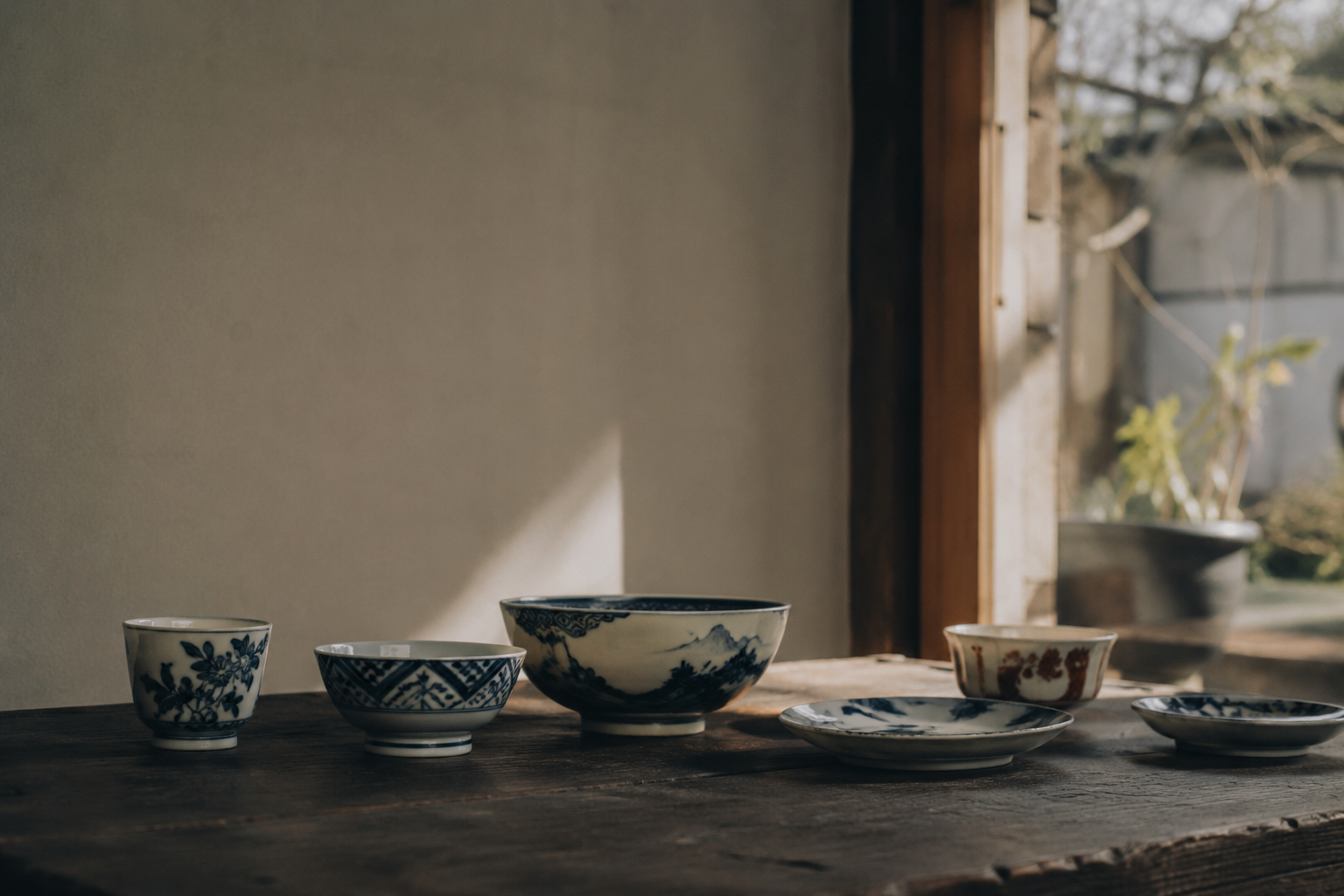
Porcelain (磁器, jiki) is made from ground stone. It fires hard, white and non-porous. Tap it and it rings. Hold a thin piece to a window and light comes through. It’s the material of Arita, Imari, Hasami and Kutani.
Pottery / stoneware (陶器, tōki) is made from clay. It’s heavier, warmer in colour, slightly porous, and it thuds rather than rings. It’s the material of much of Mino and Seto, and of most of the rustic, earthy Japanese ware you see in tea ceremony contexts.
Neither is better. They’re different materials for different moods. But if you’re wondering why one “Japanese bowl” weighs twice what another does, this is why.
Arita (Saga Prefecture) — where Japanese porcelain began
What it is: Porcelain. The original.
Japanese porcelain starts here in 1616, when a Korean potter named Yi Sam-pyeong — known in Japan as Kanagae Sanbee — found usable porcelain stone at Izumiyama in Arita. Before that, Japan imported its porcelain from China.
The local Amakusa pottery stone is unusually white, which is why Arita ware can be worked so thin and light while staying strong. Hold a good piece up to a window and it glows.
What it looks like: Everything. That’s the honest answer. Arita covers delicate blue-and-white underglaze (sometsuke), the milky-white ground with restrained enamel painting of the Kakiemon style, the gold-heavy opulence of Ko-Imari, and — since around 2012 — some of the most stripped-back modern tableware being made anywhere in Japan.
Why it matters historically: In the second half of the 17th century the Dutch East India Company began exporting Arita porcelain to Europe, where it ended up in palaces and was talked about as white gold. Much of what Europeans think of as “old Japanese porcelain” came from this one small town.
Buy it if: you want something with genuine depth of history behind it, and you’re willing to choose between very different styles rather than being handed one.
If you’re planning to go: how to buy Arita pottery in person — a first-timer’s guide to the town
Imari (Saga Prefecture) — the port, not the pottery
This is the one that confuses everyone, and the explanation takes ten seconds.
Imari was the port. In the Edo period, porcelain made in Arita and the surrounding area was carried to the harbour at Imari and shipped out from there — domestically and, via the Dutch, to Europe. Buyers named it after the port they received it from. So for a long stretch of history, “Imari ware” and “Arita ware” described the same objects, distinguished only by which end of the journey you were standing at.
Later, when rail replaced sea freight, the naming settled down: pieces made in the Arita area became Arita ware, and pieces actually made in the Imari area became Imari ware.
What confuses people today: In the Western antiques trade, “Imari” still refers to a style — the dense red, blue and gold export pattern — regardless of where it was made. European factories copied it enthusiastically. So an antique dealer saying “Imari” and a Japanese shop saying “Imari” may mean two completely different things.
Worth knowing: Imari’s Okawachiyama, a village tucked into the mountains, was where the Nabeshima lords kept their official kiln — producing exceptionally refined overglaze work that was never sold commercially at the time, only given as gifts among the elite. The village still has kilns and workshops, and it’s about as different from a modern shopping complex as you can get.
Buy it if: you want the historical export style, or you’re going to Kyushu and want somewhere quiet and atmospheric alongside Arita.

Hasami (Nagasaki Prefecture) — the one that had to start over
This is the best story in Japanese ceramics, and it’s barely told in English.
Hasami sits immediately over the prefectural border from Arita — close enough that for most of its history it shared kilns, clay suppliers and workers with its neighbour. Its own tradition began at roughly the same time, in the early 1600s, and by the mid-17th century Hasami was producing more pottery than anywhere else in Japan. Its signature was the kurawanka bowl — cheap, sturdy, unpretentious everyday ware named after the call of the boat vendors who sold food on the rivers.
But Hasami had no railway station. Arita did. So from the Meiji era onward, Hasami’s output was shipped out of Arita station and sold, nationwide, as Arita ware. For over a century, an enormous quantity of what Japan bought as Arita porcelain was actually made in Hasami.
Then, around 2000, a series of food origin-mislabelling scandals — the beef fraud cases being the most notorious — triggered a nationwide tightening of regional origin labelling. The rules applied well beyond food. Hasami could no longer be sold as Arita.
Overnight, a four-hundred-year-old production centre found itself with a name nobody recognised.
What happened next is the interesting part. Rather than trying to imitate Arita’s prestige, Hasami went back to what it had always actually been good at: affordable, well-made, everyday tableware — the kurawanka philosophy, updated. Modern shapes, simple glazes, stackable, dishwasher-safe, priced for real households. The wholesaler Saikai Toki pushed the name nationally; in 2010 Maruhiro launched the design brand HASAMI. Within a decade, Hasami ware went from unknown to a fixture in Japanese lifestyle and design shops.
What it looks like: Clean, modern, unfussy. Solid colours, simple forms, minimal decoration. It is the porcelain equivalent of a well-designed everyday object rather than a display piece.
Buy it if: you want pieces you’ll use every single day without thinking about them. Best value-for-quality in Japanese ceramics, in my opinion — and if you’ve ever bought Japanese porcelain from a design shop and thought it looked refreshingly modern, there’s a decent chance it was Hasami.
Mino (Gifu Prefecture) — the one you already own
What it is: Mostly stoneware, some porcelain. And it is everywhere.
Mino ware, made around Tajimi and Toki in Gifu, accounts for the largest share of Japanese domestic tableware production by a wide margin — figures vary by source, but roughly half of the tableware used in Japanese homes is Mino ware. If you own a Japanese bowl and don’t know where it’s from, statistically this is the safest guess.
What it looks like: Mino’s fame rests on four historic tea-ceremony styles, all developed in the late 16th and early 17th centuries:
- Shino — thick, milky white feldspar glaze, often crazed, sometimes with faint orange scorching. Japan’s first true white ceramic.
- Oribe — bold copper-green glaze and deliberately irregular, asymmetric forms. Named after the tea master Furuta Oribe, who liked things a bit wrong on purpose.
- Kiseto — soft yellow, restrained.
- Setoguro — deep matte black, pulled from the kiln while still hot.
Alongside those, Mino produces vast quantities of ordinary modern tableware in every conceivable style.
Buy it if: you want the earthy, tactile, imperfect side of Japanese ceramics — Shino and Oribe are the opposite of Arita’s precision, and many people who find porcelain too formal fall for these immediately.
Kutani (Ishikawa Prefecture) — the loud one
What it is: Porcelain, and unmistakable.
Kutani ware comes from the Kaga region of Ishikawa on the Sea of Japan coast. Production began in the mid-1600s, stopped for reasons still debated, and was revived in the early 19th century.
What it looks like: Colour. Kutani is defined by overglaze enamel painting in a bold five-colour palette — green, blue, yellow, purple and a deep red — often covering the entire surface, often with gold. Where Arita’s blue-and-white is restrained and Hasami is minimal, Kutani is maximal. A Kutani piece is not a background object.
Practical warning: the overglaze enamels and gold on decorative Kutani are frequently not dishwasher-safe, and gold is never microwave-safe. Check before you buy, and if in doubt, wash it by hand.
Buy it if: you want one striking piece rather than a set — a single small dish or a sake cup. Kutani rewards being looked at.
Seto (Aichi Prefecture) — the name that became the word
Worth a short mention because of a piece of trivia that explains a lot.
Seto has produced ceramics for roughly a thousand years — longer than anywhere else on this list. It became so dominant historically that setomono (瀬戸物), literally “Seto things,” became the ordinary Japanese word for ceramics in general. Like “hoover” for vacuum cleaner.
So if a Japanese person calls something setomono, they usually just mean crockery, not ware from Seto specifically.
Quick reference
| Name | Where | Material | Character | Best for |
|---|---|---|---|---|
| Arita | Saga | Porcelain | Ranges from delicate traditional to stark modern | A considered piece with history |
| Imari | Saga | Porcelain | Historically = Arita; in the West, the red/gold export style | Antiques, or a quiet trip |
| Hasami | Nagasaki | Porcelain | Clean, modern, everyday | Daily-use pieces, best value |
| Mino | Gifu | Mostly stoneware | Earthy, tactile, Shino & Oribe | Rustic warmth, tea bowls |
| Kutani | Ishikawa | Porcelain | Bold five-colour overglaze, gold | One statement piece |
| Seto | Aichi | Both | The oldest; also the generic word | General ceramics |
So which should you buy?
Skip the names for a moment and answer three questions instead.
What’s it for? Daily use → Hasami or everyday Mino. A gift or a piece you’ll display → Arita or Kutani. Tea, or something you want to hold → Mino stoneware.
Do you want it to disappear or be noticed? Hasami disappears into a table beautifully. Kutani never disappears anywhere.
Porcelain or stoneware? If you like light, hard, cool and precise: porcelain. If you like weight, texture and slight irregularity: stoneware.
Then check the name, and use it as a shortcut for narrowing down rather than as a guarantee of style.
One last practical point, and it’s the one I’d actually press: shops that name the kiln are worth more than shops that don’t. “Japanese ceramic bowl” tells you nothing. “Arita ware, Gen-emon Kiln, sometsuke underglaze” tells you the region, the maker and the technique, which means you can look them up, find their other work, and buy the next piece with confidence. It is the single best signal of whether a retailer knows what they’re selling.
If you’re buying online, MUSUBI KILN does this on every product page, which is why it’s the one I recommend to people starting out.
And if you’d rather choose with your hands — which for one-off pieces I’d argue is worth the trip — here’s how a day of pottery shopping in Arita actually works.
Related reading: How to buy Arita pottery in person · Where to buy Japanese pottery online: shops compared

Comments