This article contains affiliate links. If you buy through them I may earn a small commission, at no extra cost to you.
- Buying pottery online is fine. Buying it in Arita is different.
- Who this guide is not for
- Getting there from Fukuoka
- Stop 1: Kouraku Kiln, for the treasure hunt
- Stop 2: Arita Será, for the actual shopping
- Stop 3 (for the bargain hunters): KANEZEN Factory Shop
- About carrying it all home
- In person vs. online: how to decide
- The short version
Buying pottery online is fine. Buying it in Arita is different.
You can order beautiful Japanese porcelain from your sofa. I’ve done it, I recommend it, and for most people most of the time it’s the sensible choice.
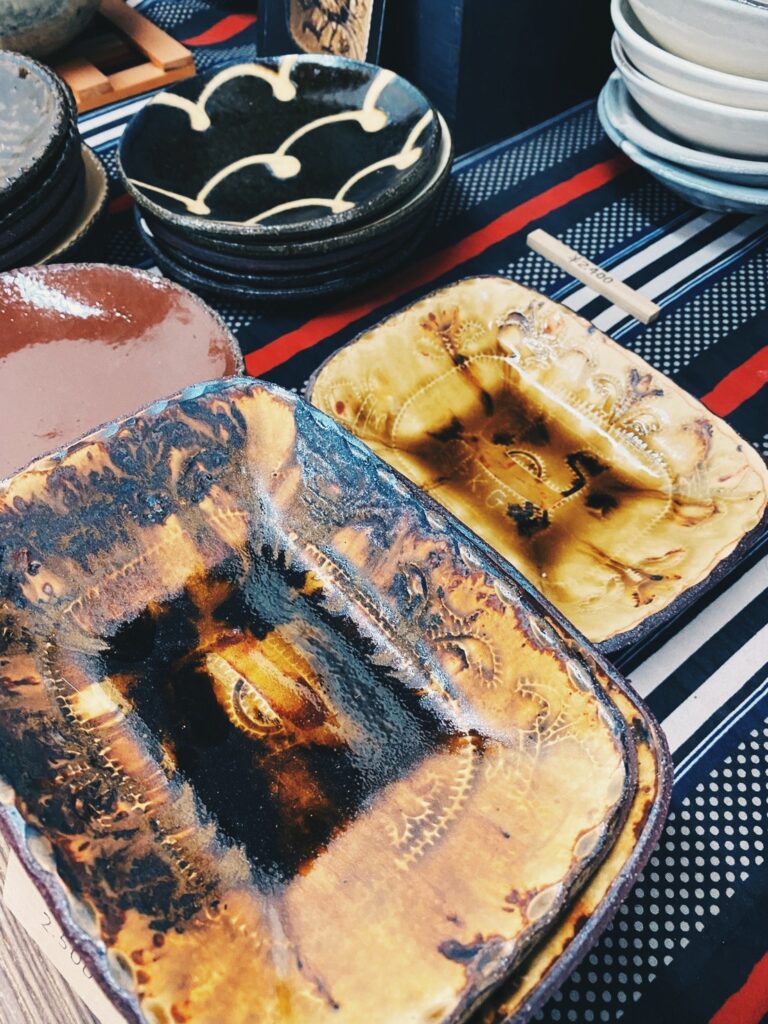
But there’s one situation where it isn’t: when you care about the piece being this piece and not one like it. Handmade porcelain varies — the weight in your hand, the exact blue of the underglaze, the tiny pooling of colour where the glaze ran. A photograph flattens all of that. If you’re the kind of person who wants to pick up three near-identical bowls and buy the one that feels right, no website can do that for you.
That’s what a day in Arita is for.
Arita is a small town in Saga Prefecture, in northern Kyushu, and it’s where porcelain was first made in Japan four hundred years ago. It’s still making it. You can get there and back from Fukuoka in a day, walk into shops run by kilns that predate most countries, and carry home something you chose with your hands.
This is how I’d tell a friend to do it.
Who this guide is not for
If you want convenience over the object itself, buy online. A day trip to Arita is a full day, and the town is spread out. If the piece matters more than the trip, that’s a completely valid choice, and I’ve put my online recommendation at the end.
If you’re going during Golden Week specifically for a relaxed browse, reconsider. The Arita Ceramic Fair (late April to early May) pulls in hundreds of thousands of people. It’s spectacular, but it’s the opposite of quiet. Go for the fair, or go deliberately outside it — not by accident.
If you can’t carry weight. Porcelain is heavy and you’ll buy more than you plan to. If you’re travelling light or have a long onward journey, sort out shipping before you start buying, not after.
Getting there from Fukuoka
Arita is doable as a day trip from Fukuoka (Hakata). The rough route is Hakata to Arita by train, around 80 minutes depending on the connection, usually via the Sasebo Line.
A day is enough for the two things below. An overnight lets you slow down and see the town empty out at five, which is the best part — but if your schedule is tight, leave Hakata in the morning and you’ll be fine.
If you’d rather not plan the logistics, there are guided Kyushu pottery day tours that bundle Arita with nearby Imari — see options on Klook. For staying over, the onsen town of Ureshino is close and better value than lodging in Arita itself — Ureshino ryokan on Agoda.
Stop 1: Kouraku Kiln, for the treasure hunt
Start here, because it’s the most fun and it loosens you up for the day.
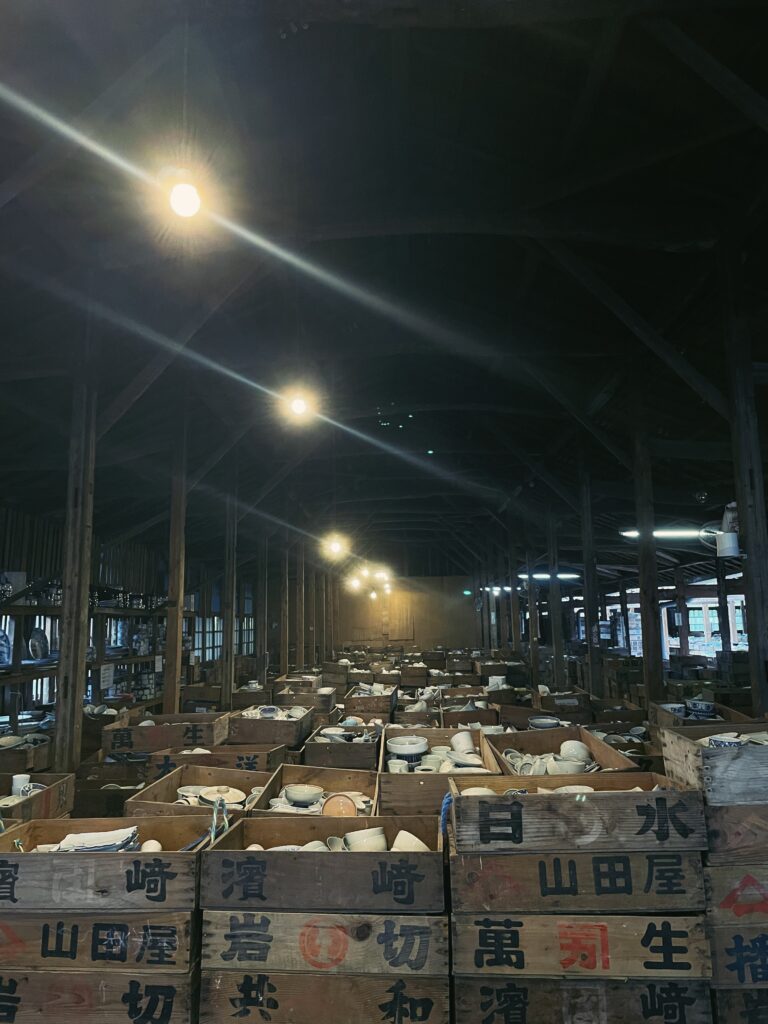
Kouraku Kiln (幸楽窯) was founded in 1865 and runs a “treasure hunting” experience that has quietly become one of the most popular things to do in Arita, including for overseas visitors. Here’s how it works: you pay a set price, you’re handed a basket, and you fill it with whatever you like from a warehouse holding a reported 100,000 pieces — overstock, discontinued lines, seconds. Whatever fits in the basket is yours.
The current setup is two courses. The ¥6,600 course (orange basket) covers simpler everyday pieces — white porcelain, celadon, and blue-and-white sometsuke. The ¥13,200 course (black basket) opens up the hand-painted, colourful iro-e work. The baskets are the same size; what changes is which part of the warehouse you’re allowed to raid.
A few practical things I wish I’d known:
- No reservation needed — walk-ins are welcome. Sessions run up to 90 minutes, and they pack your haul for you at the end.
- Reception is split: mornings 10:00–11:00, afternoons 13:00–14:00, with the whole thing paused 12:00–13:00 for restocking and staff breaks. Don’t roll up at noon.
- Wear clothes you don’t mind getting dusty. It’s a warehouse. They hand you work gloves for a reason.
The honest caveat: treasure hunting is the best experience in Arita and the least reliable way to end up with a matched set. Go for the joy of digging, not for a specific shopping list.

Stop 2: Arita Será, for the actual shopping
This is where I spend the most money, and where I’d send anyone who’s serious about bringing something good home.
Arita Será (アリタセラ) is a porcelain shopping complex on a hill about five minutes by car from Arita Station — around 20,000 tsubo of grounds with about 22 shops, plus a hotel, restaurants and galleries. It’s open year-round, has a big car park, and the range runs from everyday tableware to gift pieces to serious one-of-a-kind art. The shops carry outlet stock and odd finds too, so it feels like a small ceramics fair on any ordinary day.
The reason I prefer it to walking the town’s scattered kilns is simple: it’s 22 shops in one place, at wildly different price points, so you can compare a ¥1,500 everyday bowl and a ¥40,000 collector’s piece within the same hour and figure out what you actually respond to.
Three shops I’d start with:
1616 / arita japan
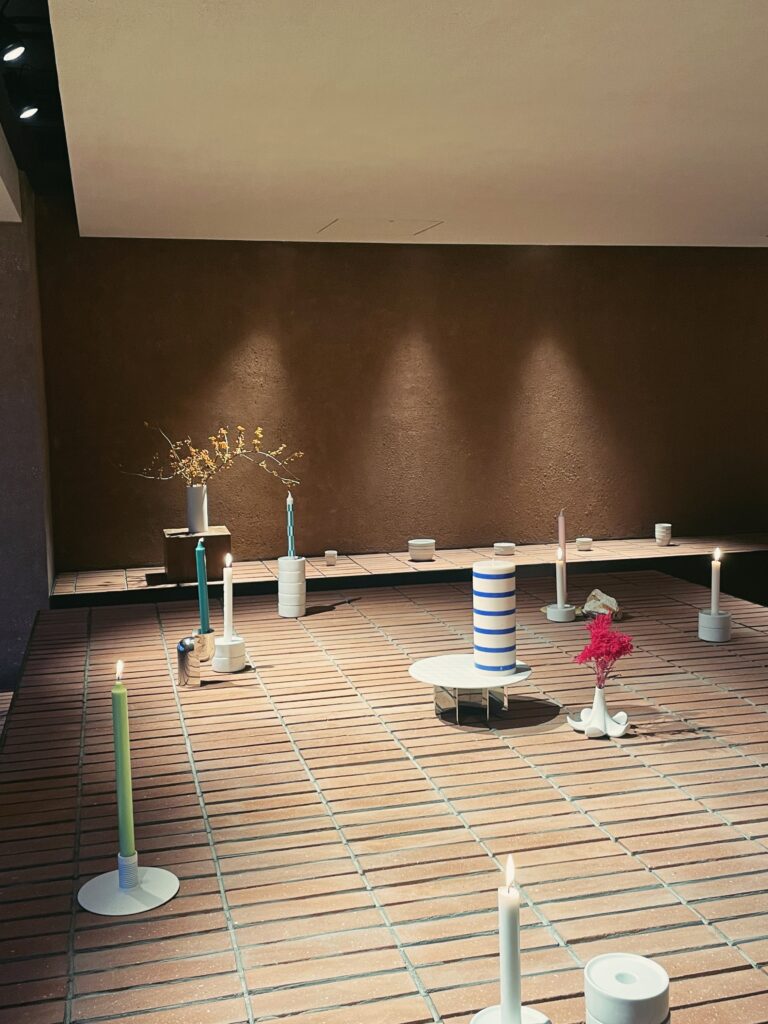
Modern Arita ware, made by Momota Toen (百田陶園), developed with designers including Teruhiro Yanagihara and the Dutch studio Scholten & Baijings. The “1616” is the year porcelain began in Arita. The work is clean, contemporary, almost architectural — thin, matte, quietly confident. If your taste runs modern rather than traditional, start here. (Their store is open roughly 9:00–17:00.)
If you’ve seen 1616 pieces stocked in design shops in New York, LA or Sydney, this is the source — and the prices here are the ones those overseas shops mark up.
MARUBUN — and where to take a break
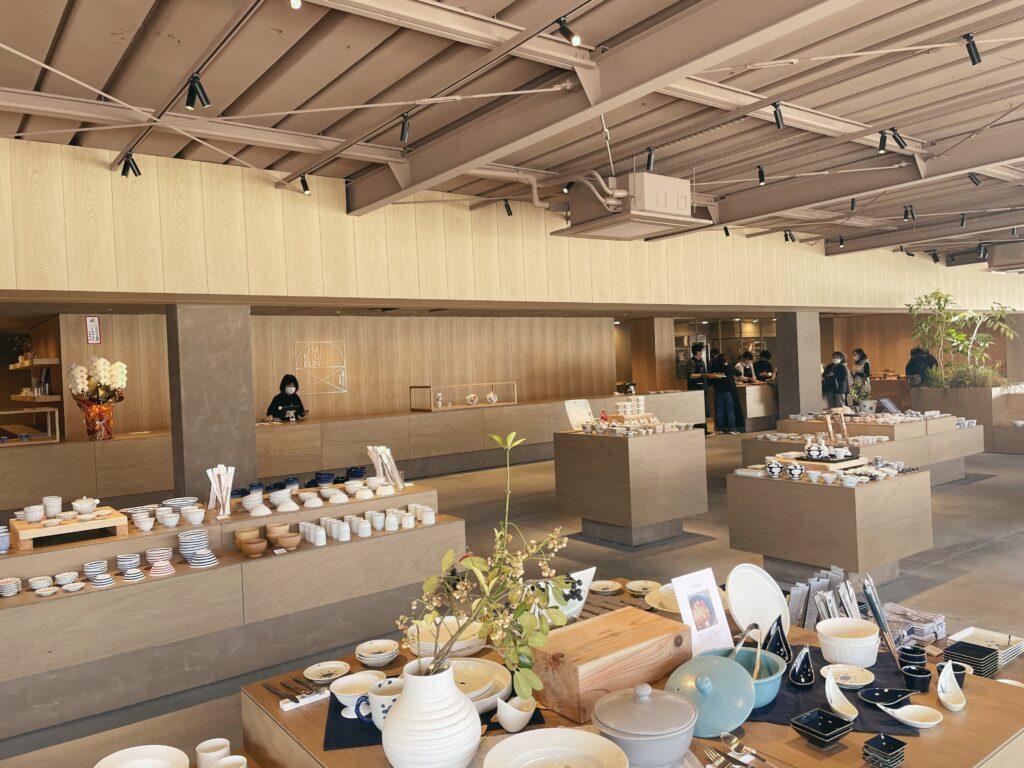
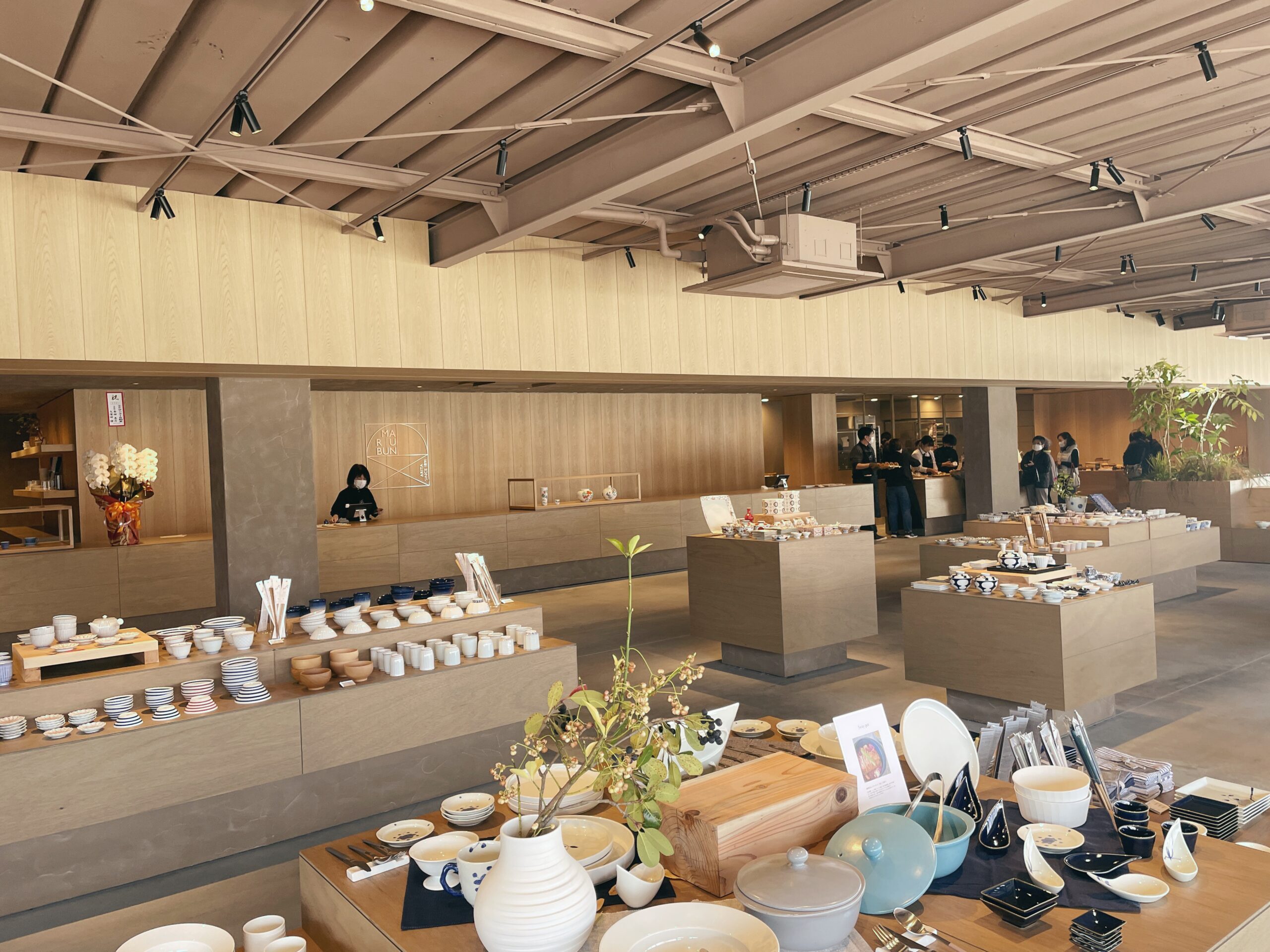
MARUBUN (まるぶん) is a porcelain trading house dating back to the Meiji era, and its Arita Será concept shop is the one I’d tell you to build a rest stop around. It reopened in December 2022 with a bakery café attached, and the space is genuinely well done — mortar floors, a lot of warm wood, careful lighting. The kind of shop that’s stylish without being cold.
The display work is a cut above. This is where I stood over a row of donburi bowls for far too long, because they were laid out so well I wanted all of them. The shop leans toward warm, hand-painted originals, and includes their signature “ultimate ramen bowl,” designed specifically to make instant ramen taste better at home — which is exactly the kind of unpretentious, practical idea that makes Arita ware likeable.
The reason to plan around MARUBUN, though, is the bakery. They bake more than 30 kinds of bread in-house daily, some using local Arita ingredients, and you can eat in — served on MARUBUN’s own porcelain — or take away. Halfway through a day of shopping, a coffee and fresh bread served on the ware you’re deciding whether to buy is both a rest and a sales pitch. Hours run roughly 11:00–17:00 on weekdays and 10:00–17:00 on weekends and holidays.
The traditional houses and the one-off galleries
Beyond the two design-led names, Arita Será has shops carrying classic hand-painted work and at least a couple showing high-end single pieces — the ones displayed alone, with space around them, priced accordingly. Even if you’re not buying at that level, walk through. Seeing the top of the craft recalibrates your eye for everything else.
Stop 3 (for the bargain hunters): KANEZEN Factory Shop
If treasure hunting gave you a taste for the thrill of digging for a deal, add one more stop — but check the calendar first.
KANEZEN (金善製陶所 / 金善窯) is an Arita kiln with around 70 years of history, making both household and commercial tableware. In May 2023 they opened a factory shop in part of their working factory, stocked with outlet pieces — a lot of them, across a wide range.
“Outlet” here means second-grade and inspection-reject stock: small iron specks, pinholes, slight unevenness in the glaze or painting, the occasional faintly warped rim on a mug. Nothing cracked, and — this is the point — nothing that matters for everyday use. You’re getting the same kiln’s work at a fraction of the shelf price, in exchange for tiny imperfections most people would never notice.
Their everyday style is clean and modern — the “hai bowl” series in colours like deep ultramarine, sumi black and bronze-gold is a good example of what they do well, and it photographs beautifully.
The catch you must know: the factory shop is open 10:00–18:00 and closed on weekends and public holidays. It’s a working factory, so if your Arita trip lands on a Saturday or Sunday — as most day trips do — you can’t go. Plan a weekday, or skip this one. It also isn’t inside Arita Será; it’s at the KANEZEN factory itself, so it’s a separate short hop rather than another shop in the same complex.
About carrying it all home
Two honest warnings from experience.
You will buy more than you planned. Everyone does. The everyday pieces are inexpensive enough that “just one more” happens five times.
Sort out shipping before your last purchase, not after. Some shops in Arita Será will ship, and — importantly for international readers — some will handle overseas shipping for you. Ask before you buy, because it changes what’s practical to take. If you’re carrying pieces yourself, remember Arita is on a slope and you may have train changes ahead; a bag of porcelain gets heavy fast.
In person vs. online: how to decide
Here’s the actual decision, stripped down.
Buy in person if: you enjoy choosing the individual piece, you care about one-of-a-kind items, and you have a full day. Seeing a one-off gallery piece in your hands before buying is something no website replicates — and if that’s the part you love, the trip is the point.
Buy online if: you know roughly what you want, you’re buying a gift, or a trip to Kyushu isn’t on the cards. You lose the hand-picking, but you gain your weekend back.
For online, the shop I recommend is MUSUBI KILN — Japan-based, ships worldwide, and names the kiln and region on every product, which most international retailers don’t bother to do. Several of the Arita houses you’d meet in person are represented there.
The short version
If you can get to Kyushu: spend a morning digging at Kouraku Kiln’s treasure hunt, an afternoon at Arita Será, and ask about shipping before your final purchase. Budget more than you think, both in yen and in bag space.
If you can’t: start with MUSUBI KILN online, and let your first few pieces teach you what you like before you plan the trip.
Either way, the thing that makes Arita porcelain worth the effort is the same — it’s made by people, one piece at a time, in a town that’s been doing it for four centuries. Whether you choose your piece with your hands or a mouse, that part doesn’t change.
Related reading: Arita, Hasami, Mino, Kutani — what the names actually mean · Where to buy Japanese pottery online: 6 shops compared · A quiet 48 hours in Saga, the prefecture most travellers skip

Comments