This article contains affiliate links. If you buy through them I may earn a small commission, at no extra cost to you.
Japan doesn’t have “a” pottery style. It has dozens of towns.
Most people meet Japanese ceramics in a department store or a Kyoto gift shop — beautiful pieces, but stripped of context, like hearing a song without knowing which instrument played it. The way to actually understand Japanese pottery is to know that it isn’t one tradition. It’s a scatter of towns across the country, each with its own clay, its own kilns, and its own four-hundred-year argument about what a bowl should be.
Some make delicate white porcelain that rings when you tap it. Others make heavy, unglazed stoneware that looks like it was pulled from the earth an hour ago — because in a sense it was. Knowing which town made a piece tells you most of what you need to know about it before you even pick it up. (If you want the deeper version of that, here’s what the regional names actually mean.)
Here are eight towns worth knowing — whether you’re planning a trip or just want to understand what you’re buying.
The porcelain towns
1. Arita (Saga) — where it all began
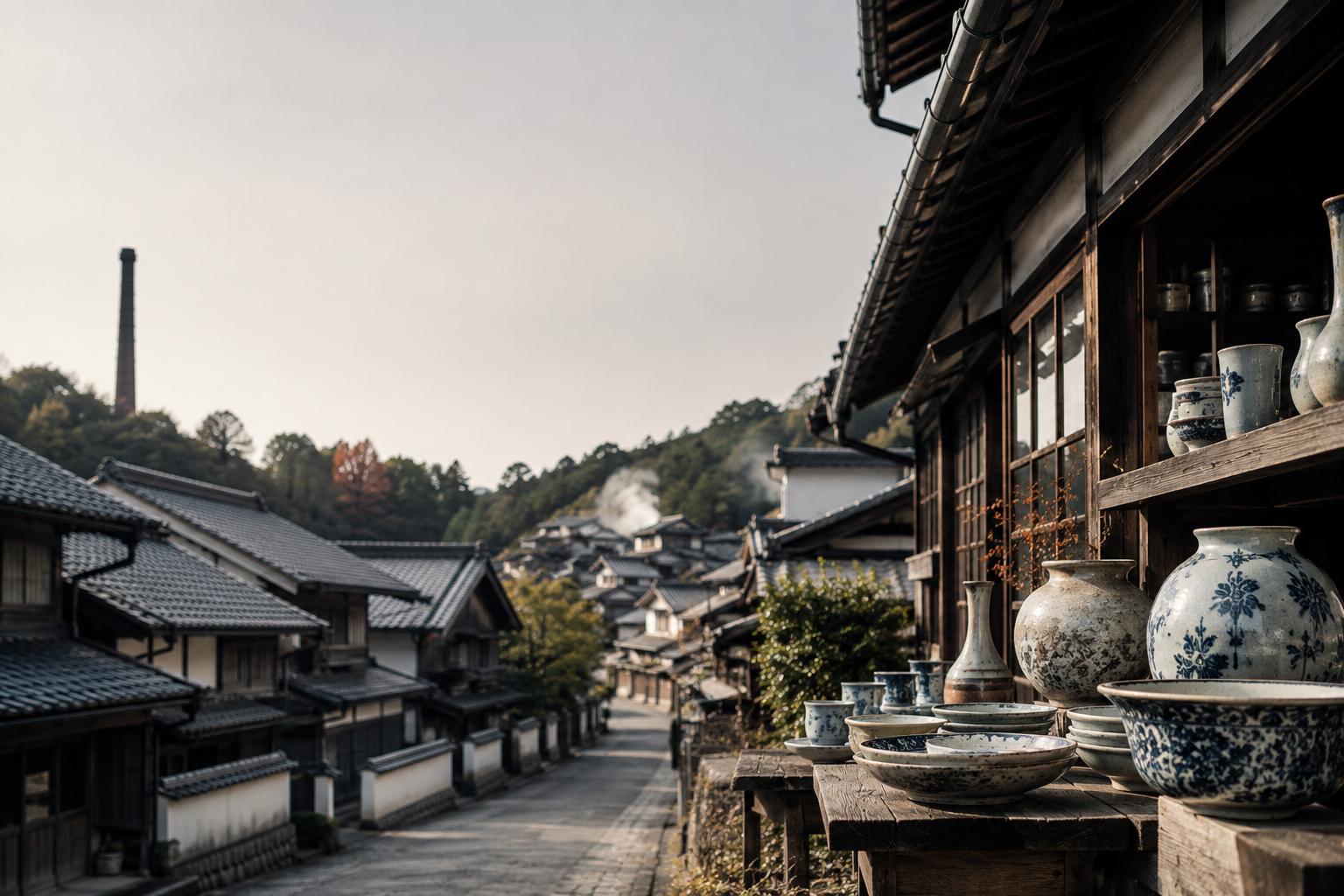
Arita is the one to understand first, because Japanese porcelain starts here. In 1616, porcelain stone was discovered nearby, and for the first time Japan could make the hard, white, translucent ware it had until then imported from China. Arita’s blue-and-white pieces were shipped out through the port of Imari to Europe, where they ended up in palaces.
Today the town is dense with kilns, museums, and shops — from ¥500 everyday bowls to collector pieces displayed alone under their own lights. There’s a shrine with a torii gate made of porcelain, and a treasure-hunting warehouse where you fill a basket for a set price.
Of all eight towns here, Arita is the one I know best and keep going back to. If you’re planning to visit and actually shop, I’ve written the full day: how to buy Arita pottery in person, and a slower 48-hour Saga itinerary that pairs it with a hidden kiln village and an onsen.
Known for: fine blue-and-white and modern porcelain · Get there: JR Sasebo Line, ~80 min from Hakata
2. Imari / Okawachiyama (Saga) — the secret kiln village
Fifteen minutes from Arita, tucked into a steep valley, is Okawachiyama — once the official kiln of the Nabeshima lords, producing porcelain so fine it was made only as gifts for the shogun. The techniques were secret, the valley was gated, and today around thirty kilns still work there, descendants of those original potters. Even the town map is made of porcelain.
It’s the quiet, atmospheric counterweight to Arita’s bustle, and my favourite half-day in the whole region.
Known for: refined Nabeshima-style porcelain · Get there: short taxi/bus from Imari Station
The everyday-ware towns
3. Hasami (Nagasaki) — the modern everyday champion
Just over the border from Arita, Hasami made porcelain for four centuries — and for most of that time it was sold as Arita, because Hasami had no railway station. When origin-labelling rules tightened around 2000, Hasami had to strike out under its own name, and reinvented itself around clean, modern, affordable everyday tableware. If you’ve bought refreshingly simple Japanese porcelain from a design shop lately, it may well have been Hasami.
Known for: clean, modern, affordable daily tableware · Get there: near Arita; bus or car
4. Mashiko (Tochigi) — the folk-craft town near Tokyo
The most accessible town on this list for anyone based in or visiting Tokyo — about two to three hours away. Mashiko is young by Japanese standards (its pottery dates to the late Edo period) and is known for warm, earthy, hand-thrown folk pottery. You can walk Jonaizaka street past more than 30 shops, and many kilns offer workshops where you make a piece and have it mailed to you after firing.
Its twice-yearly pottery fairs (spring and autumn) are among the best in the country.
Known for: rustic folk stoneware, hands-on workshops · Get there: ~2–3 hrs from Tokyo
The ancient stoneware towns (the Six Ancient Kilns)
Japan has six kiln towns recognised as the “Six Ancient Kilns” — sites making pottery continuously since medieval times, in a purely Japanese tradition that predates Chinese and Korean porcelain influence. Four are especially worth a visit.
5. Shigaraki (Shiga) — wabi-sabi and giant raccoon dogs
Shigaraki clay fires to a warm reddish tone flecked with green, rustic and irregular — the very embodiment of wabi-sabi, and long prized for tea ceremony ware. It’s also, endearingly, the town that produces Japan’s iconic tanuki (raccoon dog) statues, which you’ll see everywhere. The Ceramic Cultural Park and old climbing kilns make it a rewarding day.
Known for: rustic tea ware, tanuki statues · Get there: Shigaraki Kōgen Railway, via Kyoto/Kusatsu
6. Bizen (Okayama) — pottery with no glaze at all
Bizen ware is unglazed and unpainted — its entire character comes from the clay and the fire. Pieces are fired for days in wood kilns, and the ash, flame and placement in the kiln leave the surface mottled, scorched and utterly unique. No two are alike. For collectors who love the raw, earthy end of ceramics, Bizen is a pilgrimage.
Known for: unglazed wood-fired stoneware · Get there: JR Akō Line, ~35 min from Okayama
7. Tokoname (Aichi) — red clay and the perfect teapot
One of the oldest kiln towns, making pottery since before the 12th century. Tokoname’s iron-rich clay fires to a deep earthy red, and the town is most famous today for kyusu — the small side-handled teapots that Japanese tea drinkers swear by. The unglazed red clay is said to mellow the taste of green tea. There’s a “pottery footpath” winding through town past kilns and workshops.
A Tokoname kyusu is one of the most giftable pieces of Japanese pottery — practical, packable, and directly useful if you’ve fallen for Japanese tea.
Known for: red-clay kyusu teapots · Get there: ~30 min from Nagoya
8. Seto (Aichi) — the town that became the word
Seto has made ceramics for a thousand years, and so thoroughly dominated that setomono (“Seto things”) became the everyday Japanese word for crockery in general. It produces an enormous range, both glazed stoneware and porcelain, and its annual Setomono Festival is one of the big three pottery markets in Japan.
Known for: the whole range; the origin of the generic word for pottery · Get there: ~30 min from Nagoya
How to choose which to visit
If you only have one trip:
- Based in or near Tokyo? Mashiko — closest, with workshops you can actually do.
- Want the most important town historically? Arita — where porcelain began, and my pick for a dedicated pottery trip.
- Love the raw, earthy, imperfect side? Bizen or Shigaraki.
- A tea drinker? Tokoname, for a kyusu you’ll use for years.
- Near Nagoya? Seto and Tokoname are an easy pair.
And whichever you visit, a note learned the hard way: pottery is heavy, you will buy more than you planned, and some shops ship internationally — ask before you fill your bag.
If a trip isn’t on the cards right now, you can still bring these towns’ work home. Here’s where to buy Japanese pottery online — from shops that actually name the kiln and region, which, as with everything in Japanese ceramics, is the whole game.
Related reading: What Japanese pottery names actually mean · How to buy Arita pottery in person · A quiet 48 hours in Saga · Where to buy Japanese pottery online

Comments