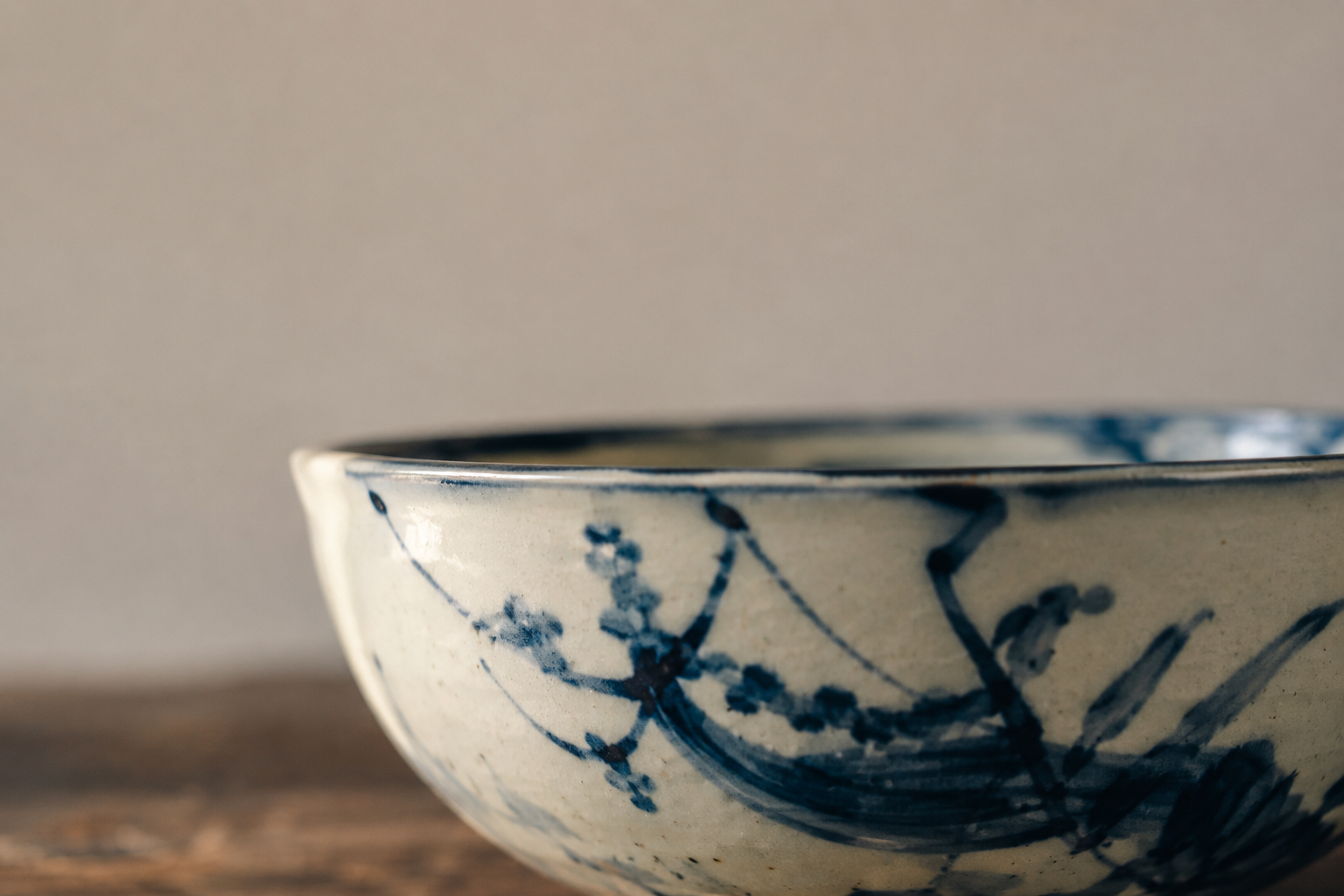
You want a rice bowl, not a research project
Here’s the situation almost everyone lands in.
You saw a Japanese bowl somewhere — a restaurant, a friend’s kitchen, a photo — and you want one. You search for it. Within ten minutes you’re looking at a listing that says “Japanese Style Ceramic Bowl, Set of 4, $29.99” and something feels off, but you can’t say what. Two tabs over there’s a single plate for $180 from a shop that won’t tell you where it ships from.
The gap between those two prices is the whole problem, and nobody explains it. The cheap listings are often not made in Japan at all. The expensive ones are frequently real, but you can’t tell which. And the middle — where most people actually want to shop — is badly served.
I buy Japanese ceramics both online and in person, from kilns in Saga and Gifu. Online, I’ve had one order arrive broken, one arrive with a customs bill I didn’t expect, and one that took the better part of three months. I’ve also found shops that get it right every time.
This is a comparison of six places worth your money, what each is good at, and where each one will annoy you.
If you’d rather understand the regional names first — Arita, Hasami, Kutani and the rest — start here, then come back.
Who this article is not for
If you want dinnerware for a family of five under $100 total. Real Japanese pottery doesn’t exist at that price. You’d be better served by good Western stoneware — nothing wrong with that, it’s a different purchase.
If you need it in under a week. Almost everything here ships from Japan. Express is 4–7 days; standard is often three weeks. Buying a present on Tuesday for Saturday won’t work.
If you’re collecting seriously — named living artists, tea ceremony ware, auction-grade pieces. That’s a different market with different gatekeepers. The shops below sell contemporary production work from established kilns. Excellent, but not that.
If you can’t tolerate variation. Handmade means each piece differs. If a slightly off-centre glaze line would bother you, buy machine-made.
How I evaluated these
Three criteria, in order.
1. Can you tell what you’re buying? The single biggest difference between shops is whether they name the kiln and region. “Japanese ceramic plate” tells you nothing. “Arita ware, Choemon Kiln, sometsuke underglaze” tells you everything — you can look up the kiln, see their other work, and know what you paid for. Shops that hide this are usually hiding something.
2. What does it actually cost delivered? Sticker price is the least interesting number. Shipping from Japan runs $15–$60 depending on weight and speed, and ceramics are heavy. Then import duty and VAT, depending on your country. A $40 bowl can land at $75. Shops that show the real total before checkout are worth paying more for.
3. What happens when it breaks? Because sometimes it does. This is where shops separate hardest. Two of the six below replaced a broken piece with one email and no argument. One asked me to file a claim with the courier myself, which for an international shipment is a polite way of saying no.
The comparison
–$$–$
| Shop | Price range | Kiln named? | Ships from | Typical delivery | If it breaks |
|---|---|---|---|---|---|
| MUSUBI KILN | Yes, always | Japan (Saitama) | 3–7 days express | Replacement, easy | |
| Japan Objects Store | Usually | Japan | 1–2 weeks | Replacement | |
| Rakuten (global) | –$$$ | Varies by seller | Japan | 1–3 weeks | Seller-dependent |
| Etsy (JP sellers) | –$$ | Varies wildly | Japan | 1–4 weeks | Seller-dependent |
| eBay (JP sellers) | –$$ | Sometimes | Japan | 2–4 weeks | Buyer protection |
| Amazon Japan | –$ | Rarely | Japan | 5–12 days | Refund, usually easy |
The six shops
1. MUSUBI KILN — the default recommendation
Best for: anyone who wants to buy once, correctly, without becoming an expert first.
MUSUBI KILN is a Tokyo-founded, Saitama-shipping retailer selling worldwide, and the thing they do better than anyone is context. It started in 2020 as a site dedicated to Kutani ware from the founder’s home region of Ishikawa, and has grown into a broad catalogue sourced from artisans across Japan. Every product page tells you the ware, the kiln, the technique and the pattern — and you can browse by kiln and by traditional motif, which sounds minor and completely changes how you shop.
Prices sit above marketplace listings — expect to pay more for a rice bowl than you would on Rakuten. You’re paying for curation, English-language service that answers within a day, insured international shipping, and free furoshiki cloth wrapping that turns anything into a gift.
Pros: Kiln, region, technique and motif named on every item. Clean English throughout. Reliable, well-insured packing. The by-kiln and by-motif browsing is genuinely useful once you know what you like.
Cons: Not cheap. The catalogue is curated, so a very specific obscure piece may not be there. Sales are infrequent.
Who it’s for: first-time buyers, gift buyers, and anyone who’d rather pay a premium than spend two hours cross-referencing kiln names.
2. Japan Objects Store — strongest editorial
Best for: people who like reading about what they’re buying.
Japan Objects grew out of a magazine about Japanese art and design, and it shows. The writing around each category is genuinely informative, and the selection leans slightly more contemporary and design-led.
Overlap with MUSUBI KILN is real — you’ll see some of the same kilns and makers. The difference is tone: MUSUBI KILN feels like a well-run shop, Japan Objects feels like a curated exhibition with a checkout.
Pros: Excellent background reading. Strong on modern makers. Good for your third or fourth piece, when you’re getting specific.
Cons: Smaller catalogue in some categories. Shipping can run a touch slower.
Who it’s for: the buyer who’s past “I want a nice bowl” and into “I want that glaze.”
3. Rakuten (international) — the deep end
Best for: people who know what they want and will work for it.
Rakuten is Japan’s largest marketplace, and effectively every kiln shop in the country has a storefront on it. The range is enormous and the prices are domestic-Japanese — often well below what curated international retailers charge.
The catch: it’s built for Japanese customers. Many product pages are in Japanese, some sellers don’t ship internationally, and English support ranges from limited to nonexistent. The workflow that works: find the kiln on a curated site first, then search that kiln’s name on Rakuten and buy direct.
Pros: Best prices. Deepest selection by far. Direct-from-kiln in many cases.
Cons: Language barrier. Inconsistent international shipping. If something goes wrong, you may be negotiating in Japanese.
Who it’s for: repeat buyers comfortable with machine translation and a little risk.
4. Etsy (Japanese sellers) — high variance, occasional gold
Best for: small independent makers you won’t find anywhere else.
There are genuine Japanese potters on Etsy, often at fair prices, sometimes shipping a piece within a week of making it. There are also many listings using “Japanese” as a style descriptor for goods made elsewhere.
My filter: does the seller name a specific place in Japan, show their studio, and answer a question about the clay body? Yes to all three, it’s usually real.
Pros: Direct contact with makers. Unique pieces. Can be very reasonable.
Cons: Requires vetting every time. Packing quality varies enormously — this is where my one breakage happened. Returns are between you and the seller.
Who it’s for: patient buyers who enjoy the hunt.
5. eBay (Japanese sellers) — underrated for the price
Best for: everyday and vintage pieces at competitive prices, with buyer protection.
A lot of Japan-based sellers list ceramics on eBay with free or cheap international economy shipping, and the platform’s buyer protection is more reassuring than a lone shop’s returns policy. You’ll find both new production and secondhand pieces — the vintage side is where it gets interesting.
The trade-off is time: economy shipping from Japan is genuinely slow, often two to four weeks, and customs charges apply on top.
Pros: Competitive prices. Real buyer protection. Good for vintage. Free economy shipping is common.
Cons: Slow delivery. Kiln information is hit-or-miss. Customs on top of the price.
Who it’s for: patient bargain hunters, and anyone after older pieces.
6. Amazon Japan — the pragmatic option
Best for: everyday pieces where provenance doesn’t matter.
Amazon’s Japanese site ships many items internationally, and there’s a lot of solid mid-range Hasami and Mino ware on it — the workhorse everyday pottery Japanese households actually use.
You’ll rarely learn the kiln. But if you want four matching bowls that survive a dishwasher and cost under $20 each, this is the efficient answer.
Pros: Familiar interface. Fast for what it is. Easy refunds. Import fees often shown at checkout.
Cons: Little to no provenance. No curation — you’re on your own. Listing quality varies.
Who it’s for: practical buyers furnishing a kitchen rather than starting a collection.
Which one should you use?
Your first piece, or a gift: MUSUBI KILN. The premium buys certainty, and certainty is worth a lot on a first purchase.
You’ve bought before and want something specific: Japan Objects Store, or Rakuten if you already know the kiln.
Best price, don’t mind effort: Rakuten, direct from the kiln’s storefront.
One-of-a-kind, and you enjoy the search: Etsy, with the three-point filter above.
Vintage or a bargain, and you’re patient: eBay.
You just need bowls: Amazon Japan.
Before you order — three things
Check the total, not the price. Add shipping and estimated duty before deciding anything is cheap or expensive.
Read the size in centimetres. Japanese rice bowls are smaller than Western cereal bowls — usually 11–13cm across — and noodle bowls are bigger. Photos won’t tell you this, and people are surprised constantly.
Check dishwasher and microwave safety. Much of it is fine. But gold-decorated Kutani and certain crackle glazes absolutely are not, and one wrong cycle will ruin the piece.
The short version
If you want one answer: start with MUSUBI KILN. They name the kiln, pack properly, ship insured, and answer emails — and your first piece will teach you enough to shop more adventurously next time.
Then, once you know which ware you actually like, find that kiln on Rakuten and save yourself money for the rest of your life.
And if a trip to Japan is on the cards — for one-off pieces, choosing with your hands genuinely beats a screen. Here’s how a day of pottery shopping in Arita actually works.
Related reading: What Japanese pottery names actually mean · How to buy Arita pottery in person


Comments