This article contains affiliate links. If you buy through them I may earn a small commission, at no extra cost to you.
The philosophy first, because it’s the whole point
There’s a wall in the porcelain town of Arita, in southern Japan, built from broken pottery. Four centuries of firings that didn’t come out right — cracked bowls, warped plates, the failures — stacked into the hillside to hold up a road. The town couldn’t bring itself to throw the mistakes away, so it built with them instead.
Kintsugi comes from the same instinct.
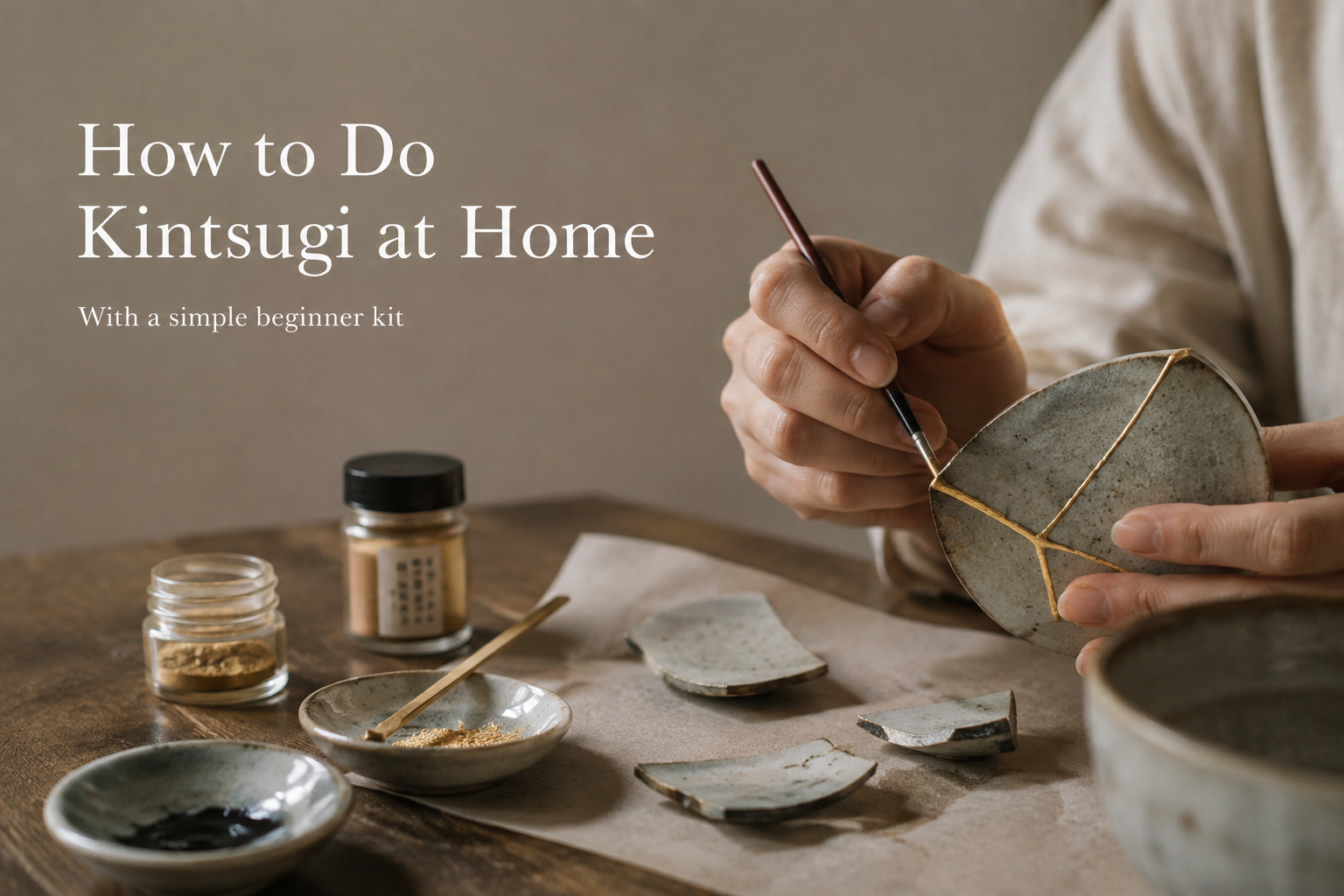
Kintsugi (金継ぎ, “golden joinery”) is the Japanese art of repairing broken pottery with lacquer and gold, so that the mended cracks become veins of gold running through the piece. The idea isn’t to hide the break. It’s the opposite: to make the break the most beautiful part. A bowl that has been broken and repaired with gold is considered more valuable than it was before it broke — not despite the damage, but because of it.
It’s tied to wabi-sabi, the aesthetic of finding beauty in imperfection and impermanence, and to a broader idea that a thing’s history — including its injuries — is part of what makes it worth keeping.
You can buy a kit and do a simplified version of this at your kitchen table. Here’s how, honestly — including what the cheap kits get right, what they leave out, and the one safety thing you must not ignore.
Traditional kintsugi vs. the kit on Amazon
Let’s be straight about what you’re actually buying, because there’s a real difference and most product listings blur it.
Traditional kintsugi uses urushi — natural Japanese lacquer — built up in thin layers over weeks or months, with real gold powder applied at the end. It’s extraordinary, it’s genuinely food-safe once cured, and it’s a serious craft. It also requires patience measured in months, and urushi can cause a nasty allergic skin reaction (it’s related to poison ivy) if you’re not careful. This is a course-and-a-mentor undertaking, not a Saturday afternoon.
The beginner kits you’ll find online almost all use a shortcut: epoxy or synthetic resin instead of urushi, mixed with gold-coloured mica powder. You get the look of kintsugi and the meditative experience of the repair in an afternoon rather than a season, with no lacquer allergy risk. What you don’t get is the centuries-old material or, in many cases, food safety (more on that in a second).
Neither is “fake.” They’re different tools for different goals. If you want to mend a sentimental mug and enjoy the process this weekend, the kit is exactly right. If you want to study a traditional craft, that’s a different and longer road.
⚠️ The one thing you must check: food safety
This is the most important paragraph in this article, so read it even if you skim the rest.
Many beginner kintsugi kits are NOT food-safe. The epoxy and mica in a standard kit are fine for decorative objects — a vase, an ornament, a bowl you’ll display — but you should not eat or drink from the repaired area unless the kit explicitly says it is food-safe.
So before you buy, decide what you’re mending:
- A decorative piece (vase, trinket dish, something for the shelf) → any beginner kit is fine.
- Something you’ll eat or drink from (a favourite mug, a rice bowl, a plate) → buy only a kit clearly labelled food-safe, and follow its full curing time before use. Some food-safe epoxy kits are dishwasher-safe after a full 24-hour cure; check the specific instructions.
If a listing doesn’t clearly state food safety and you want to use the piece for food, assume it isn’t and pick a different kit. This isn’t a detail to gamble on.
What’s in a beginner kit
A typical starter kit runs around $20 and includes:
- Adhesive (epoxy or resin glue)
- Gold-coloured mica powder (sometimes several colours)
- Brushes and mixing sticks
- Gloves
- Often a practice dish to break deliberately and mend first

That practice dish matters more than it sounds. Your first repair will not be your best, and doing it on a piece you don’t care about — before you touch the mug your grandmother gave you — is how you avoid a heartbreak on top of a breakage.
For anything you’ll actually eat or drink from, spend a little more on a food-safe set:
How to do it: the basic method
Every kit differs slightly, so follow yours — but the shape of the process is always roughly this.
- Clean and dry the broken edges. Any dust or oil weakens the bond. Make sure the pieces are completely dry.
- Mix the adhesive. Most kits use a two-part epoxy — equal parts A and B, mixed thoroughly. You usually have a working window of a few minutes before it starts to set, so don’t mix until you’re ready.
- Mix in the gold powder, or apply it after. Kits vary: some have you tint the glue gold, others have you glue first and dust gold onto the wet seam. Follow your kit.
- Join the pieces and hold them in place. Press firmly, align carefully, and wipe excess immediately — cured epoxy is hard to remove.
- Let it cure fully. This is where patience earns its keep. Quick-set epoxies may be touch-dry in minutes but need many hours to fully harden. Food-safe kits often need a full 24 hours before use. Don’t rush this step; it’s the difference between a repair that lasts and one that fails.
- Clean up the gold line. Once cured, gently tidy the seam. The goal isn’t a perfect hairline — it’s a confident, visible vein of gold.
The whole active process is maybe thirty minutes of work, wrapped around a long wait. It’s genuinely calming — closer to the reason people take up pottery or knitting than to a household chore.
Missing pieces and bigger breaks
What if a chip is gone entirely, or a piece shattered into fragments too small to find?
Traditional kintsugi has an answer for this too: gaps can be filled and rebuilt (a technique sometimes called kake-tsugi), and there’s even a practice of joining a piece with a fragment from a different broken vessel — a visible, deliberate mismatch that becomes part of the object’s story. For a beginner kit, the practical move is to use the epoxy itself, built up in layers, to fill a small missing chip before applying the gold. Larger reconstructions are where you start wanting the real craft and its materials.
Why this belongs in your home
We’re trained to see a broken bowl as rubbish — swept up, binned, replaced with an identical one from a box. Kintsugi is a quiet argument against that reflex. It says the thing you already own, the one with the history, is worth keeping precisely because it broke and you chose to mend it.
There’s something worth sitting with there, beyond the pottery. But even taken purely practically: you get to keep the mug you love, it looks more interesting than it did before, and you spent an afternoon making something instead of buying something.
Start with a decorative piece and a practice dish. Get the feel of it. Then, when you’re ready, mend the one that actually matters — the one you’d have been sad to lose.
And if the repair gives you a taste for the pottery itself, that’s a good rabbit hole to fall down: what Japanese pottery names actually mean, and how to buy Arita porcelain where it’s made — including that town with the wall built from everything that broke.
Related reading: What Japanese pottery names actually mean · How to buy Arita pottery in person · Where to buy Japanese pottery online

Comments